Prayers and advertisements: runic writing on combs

Few objects from the late Scandinavian Iron Age and early medieval world speak so intimately of daily life as the comb. Combs were so ubiquitous among Norse peoples as to be considered a universal possession, varying considerably in size and style, from the ordinary property of the humble to the valued personal treasures of the wealthy. They were most commonly fashioned from antler, prized for its durability and workability, though bone, ivory, and wood were also used. More than a practical tool for untangling hair and beard, a well-groomed appearance was considered very important, and combs were often intricately decorated and highly valued as personal possessions. Many combs were carried in small protective cases, and some bore runic inscriptions, elevating them from functional objects into bearers of language. Today, we will examine how and what early medieval people chose to write on combs, and discuss why someone might feel the need to write on such an important and therefore prized object.
There are quite a few inscribed combs. The RuneS database suggests over thirty such inscribed objects from all over Europe and spanning several hundred years, from the second century AD through to the later medieval period. Today, we will examine three different combs; the Vimose comb from late Iron Age Denmark, the Whitby comb from early medieval north eastern England, and finally the Lincoln comb case, also from England.
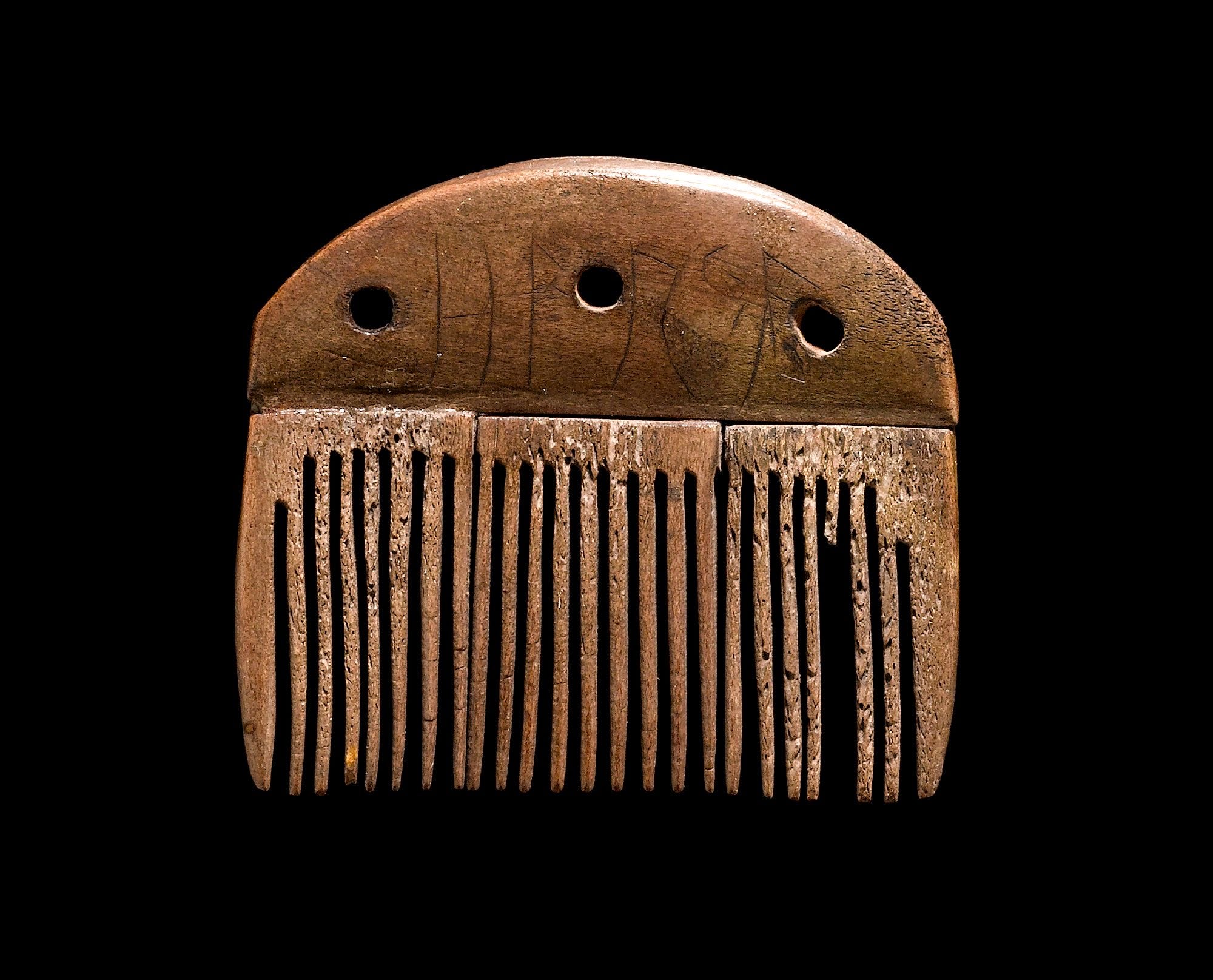
Let’s start with the earliest comb out of the three we will be discussing, which is the Vimose comb from Denmark. It is an antler comb discovered in 1865 during excavations in the Vimose bog on the island of Funen, Denmark. The comb is dated to the mid-2nd century AD, established through stratigraphic analysis of the bog deposit layers. This makes it one of the earliest runic inscriptions ever found.
The preservation of the inscription owes much to the anaerobic, waterlogged conditions of the Vimose bog, where peat layers inhibited bacterial decay and protected organic materials like bone and wood from rapid deterioration. The comb did not end up in the bog by accident. Depositional practices at Vimose involved the intentional sinking of objects into the bog as votive offerings, a ritual act, with many items exhibiting deliberate breakage to render them unusable after they had been sunk in the bog. The comb, then, was not lost, discarded, or part of the funerary rites for a deceased person, but instead offered up in a ritual act that transformed a personal grooming object into something sacred.
The inscription consists of five Elder Futhark runes reading ᚺᚨᚱᛃᚨ harja. The inscription was carved shallowly along one side of the handle, oriented from left to right. Despite the runes being very clear, it is more difficult to determine what the word harja means, though the majority of scholarship considers it a personal name. Perhaps the presence of the personal name marks the object out as something special to the person who once owned it. Alternatively, perhaps the name was inscribed just before deposition in the bog as an act of commemoration or prayer for an individual. Sadly, we will never know the true meaning of writing a personal name on the comb, so speculation will have to suffice for now.
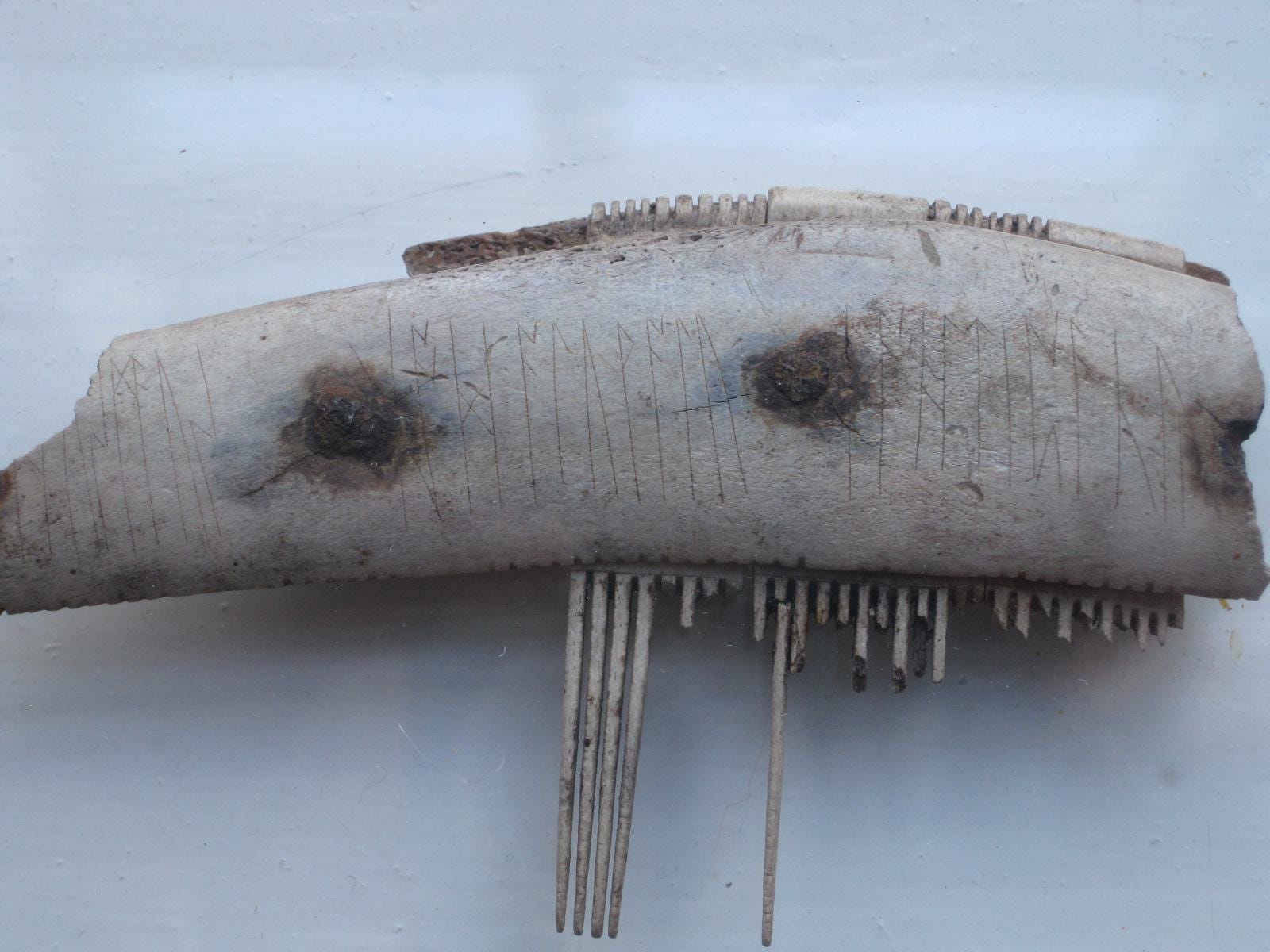
The second runic inscription we will be looking at is very different from the Vimose comb. Dated at the latest to the 9th century, the Whitby comb was found in the vicinity of Whitby Abbey in north eastern England in the late 19th century. The comb is made of a cattle rib, and is inscribed with a long runic inscription which translates as, My God, God almighty may help Cy(n)-.
The inscription stops where the comb breaks off, and the comb is damaged on the top left hand side, meaning that there is some reconstruction of the runic letters at the beginning of the text, though we are pretty certain as to what they once were. The text is really interesting for several reasons. The first is that the beginning of the text is declared in Latin; the text reads deus meus, meaning ‘my God’, and the rest of the text is written in Old English, which makes the text bilingual. Sadly, we are not sure who God is meant to help as we only have for certain the first two letters of their name. Secondly, the text is very interesting because of how it has been rendered in runes. The runes are of the Anglo-Saxon futhorc, which means they are the runes used specifically in early medieval England adapted for the sounds found in Old English. Though this is not particularly unique in itself, as there are plenty of Old English runic inscriptions written in the Anglo-Saxon futhorc, what makes this text special is that there is a triple bind rune.
A bind rune is what you get when two or more runes are merged into a single combined symbol, sharing parts of each other rather than being written out one after another in a row. The easiest way to picture it is to think of each rune as being built around a vertical line, with additional strokes branching off it. If you want to write two runes next to each other in the normal way, you draw the first, then the second. But if you create a bind rune, you use one vertical line as the backbone of both at the same time, with the extra strokes of each rune going off in their different directions from the same central spine. The person reading it then has to look at the combined shape and work out which two runes have been merged together. There were good practical reasons for doing this. Some objects do not offer much space for writing, and merging runes together allowed the carver to fit more meaning into a small area. Perhaps this was the case for the Whitby comb. Indeed, there are several bind runes throughout the text. We see bind runes in many different runic inscriptions, so what makes it special is that there is a triple bind rune, that is, three runes combined together.
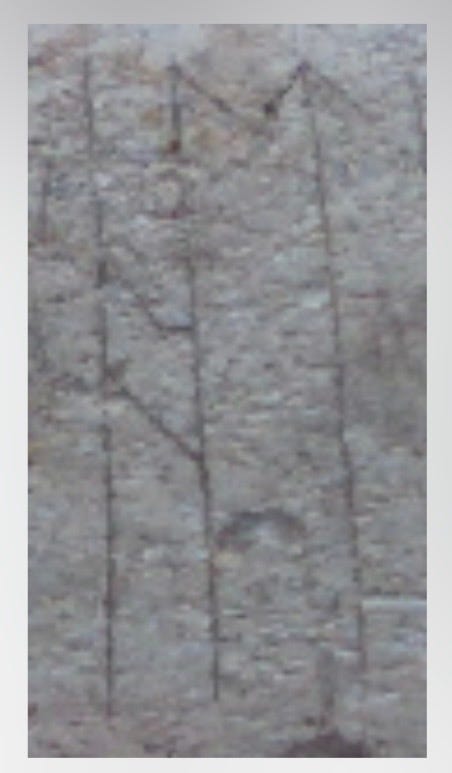
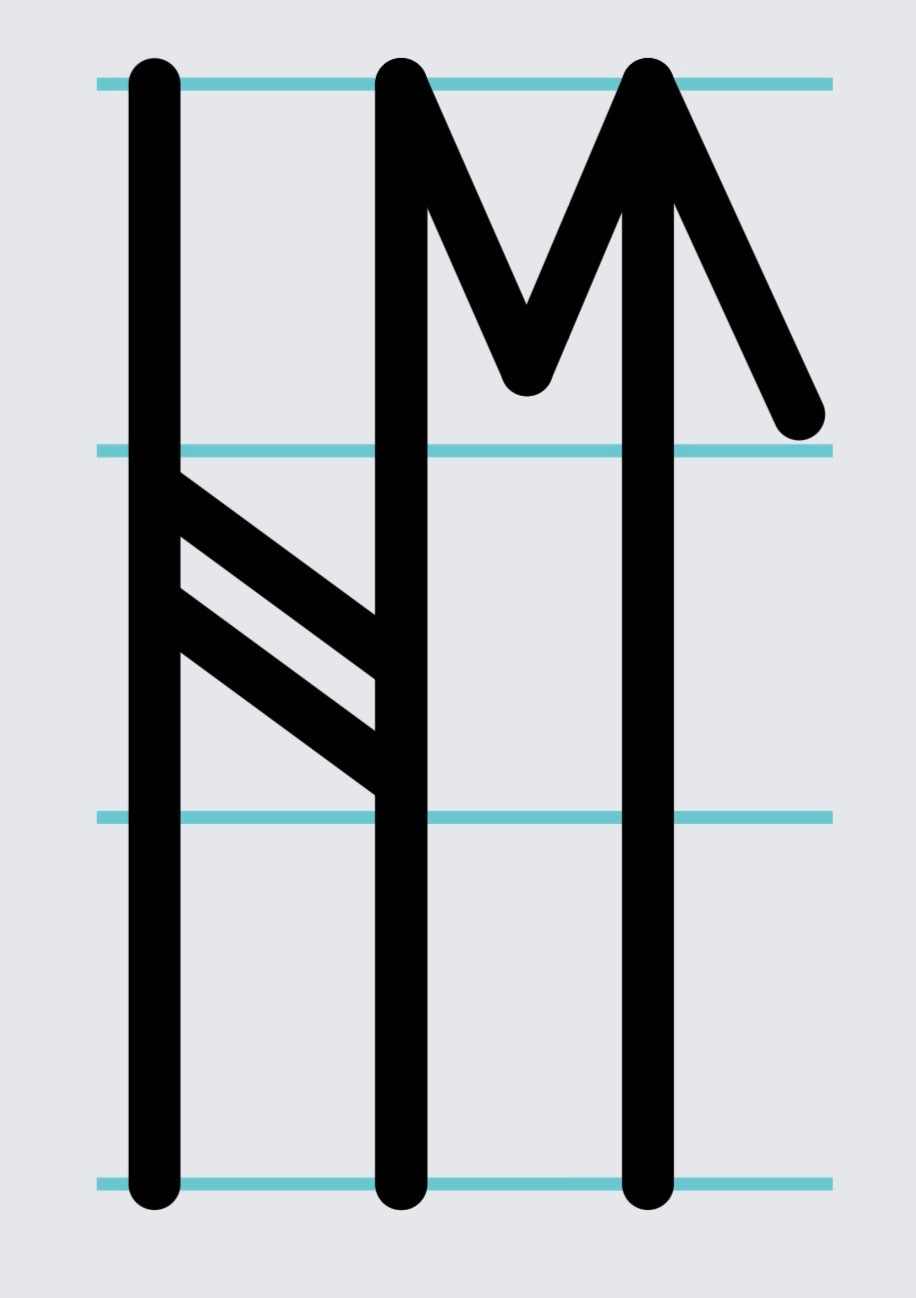
You can see above the bind runes; they combine a ᚻ rune, an ᛖ rune, and a ᛚ rune together.
Whitby Abbey was a major centre of Northumbrian Christianity, famously founded by Abbess Hild in 657 AD and the site of the Synod of Whitby in 664. It was a double monastery housing both men and women, and excavations in and around the site over many decades have produced a rich assemblage of personal objects, metalwork, and inscribed materials. The comb would fit naturally into that world of literate, devout individuals for whom a personal object bearing a prayer would have been entirely meaningful.
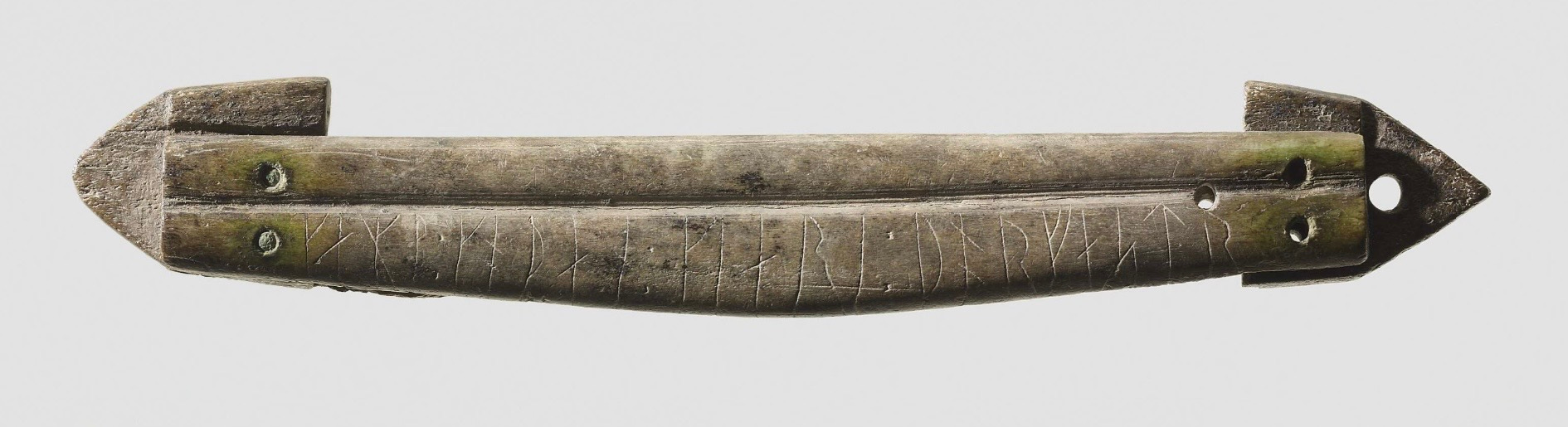
Our final comb is a 10th century comb case from the city of Lincoln, also in eastern England. Made also from cattle bone like the comb from Whitby, the comb case has along its length a runic inscription which declares, ‘Thorfast made a good comb’. It is unknown whether the runes were inscribed by Thorfast himself as a form of advertising for his comb-making business, or whether the owner inscribed them to remind themselves where to go when they needed another one. We cannot be known for sure, but what we can say is that Thorfast’s possibly legendary comb-making abilities are attested to this day. I would certainly buy a comb from Thorfast’s ghost!
The three combs examined here span almost eight hundred years and three very different worlds, yet together they reveal something consistent and compelling about the relationship between people and their most personal possessions. The Vimose comb is the oldest of the three, and in many respects the most mysterious. Deposited as a votive offering in a Danish bog in the mid-second century AD and inscribed with a personal name, it is one of the earliest runic inscriptions ever found. What we cannot recover is the precise meaning of writing a name on an object before offering it to the bog. Was it the owner's name, marking the object as theirs before giving it up? Was it the name of someone being commemorated or prayed for? The Whitby comb moves us into a completely different world. Made from cattle bone and found near Whitby Abbey, it belongs to the literate, Christian culture of seventh to ninth century northern England. Its inscription is a prayer, bilingual in Latin and Old English, asking God almighty to help a person whose name we can only partially recover. The triple bind rune, one of only two known in Anglo-Saxon runic writing, tells us that whoever carved this inscription was not a casual practitioner but someone with real command of the runic tradition. Here the comb is not a votive offering but a devotional object, something carried on the person and inscribed with words intended to draw divine protection close to the body. The Lincoln comb case brings us down to earth. Thorfast made a good comb. Just a craftsman's mark, or perhaps a satisfied customer's note to themselves. Yet in its ordinariness it tells us as much as the other two. Combs were worth remembering who made them. They were objects of quality, of pride, of daily intimate use. Who made them, and who made them well, mattered.
Taken together, these three inscriptions suggest that when people in the early medieval world chose to write on a comb, they were doing something that went beyond simple labelling. They were anchoring the object to a person, whether through a name, a prayer, or a maker's mark. A comb was carried on the body, used every day, and kept close. It was one of the most personal objects a person owned, and perhaps that is precisely why it felt like the right surface on which to inscribe something that mattered. The runic tradition, wherever it appears on these objects, seems less like decoration and more like a statement: this object belongs to someone, was made by someone, or was offered for someone. That impulse to mark something as meaningful is one we recognise across the centuries without difficulty. So, inscribed combs show us how personal runic inscriptions can truly be.
The comb is a very personal item and your description captures that well. The Vimose comb is a new one for me and in beautiful condition. Perhaps it was a personal name . That would seem likely given the context in which it was found.
The Whitby comb is familiar and a wonderful survival. Particularly significant for us in the North East of England as a part of the British Orthodox Christian tradition.
Why have I missed seeing the Lincoln Comb shield/case? It is really interesting.
Thank you for a very interesting article.